
Your Cart
Loading

FREE "Narcfree Checklists" - Workbook

On Sale
€12.50
Free Download
Added to cart

Hello dear Narcfree visitors!


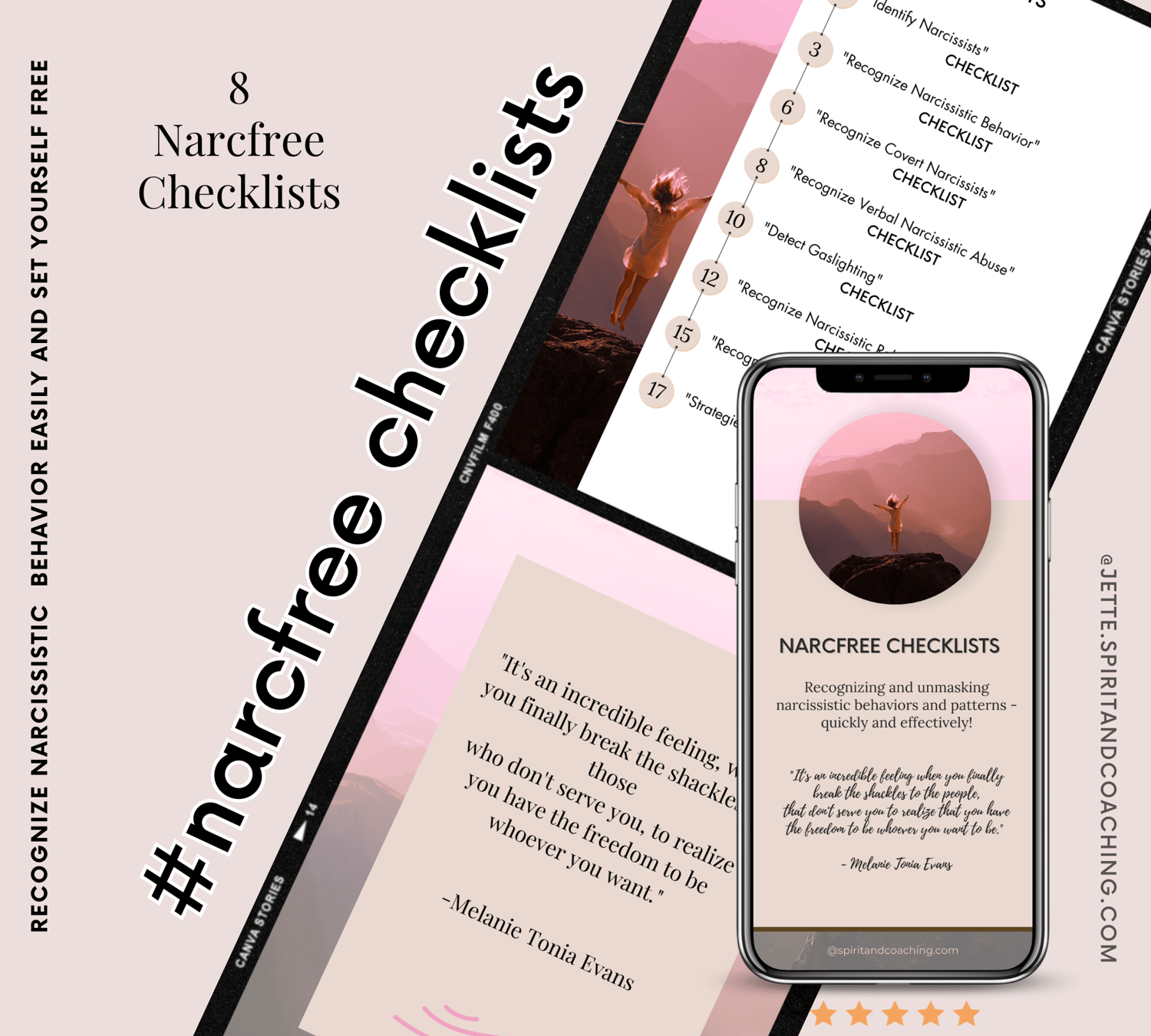
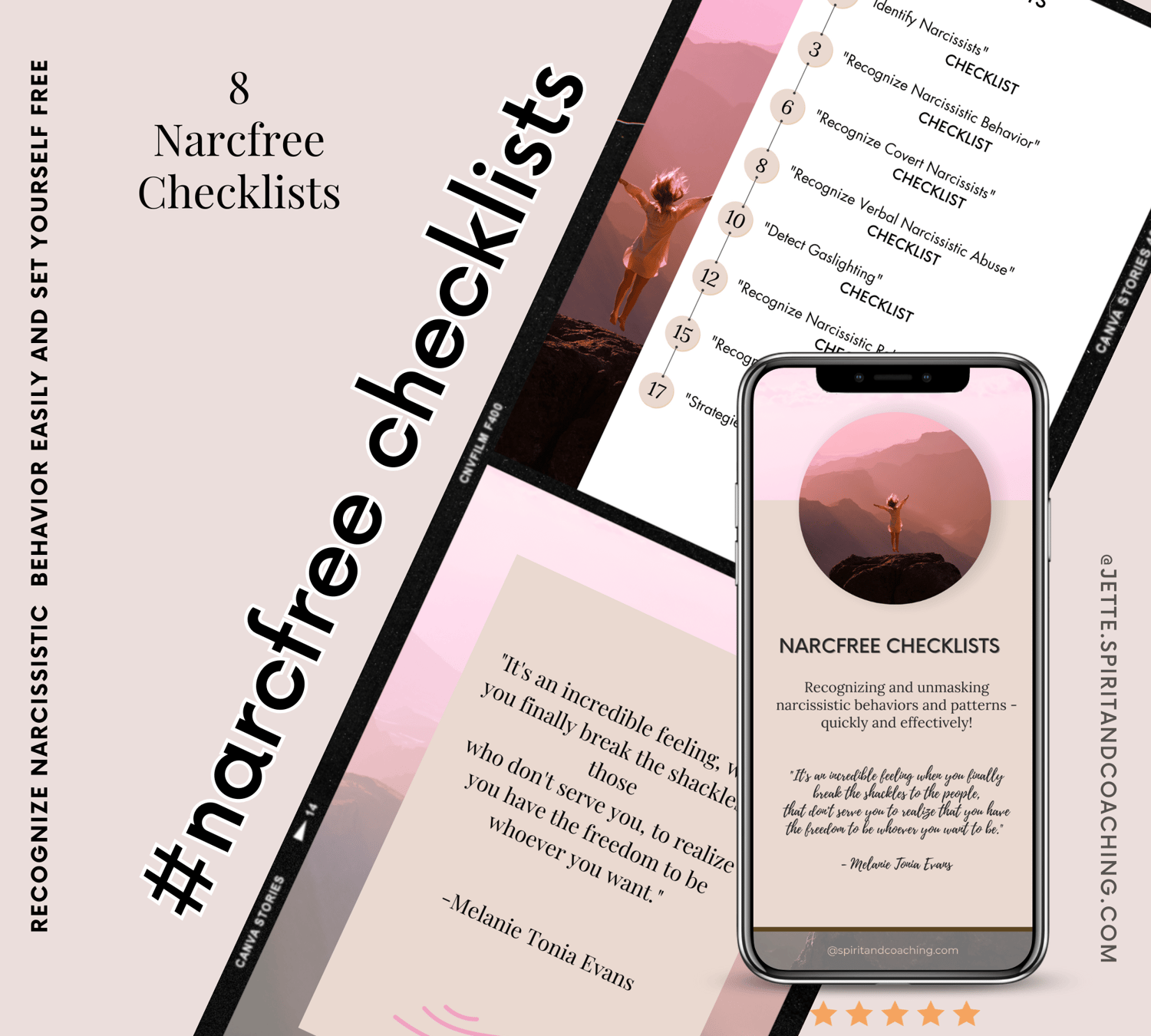
We have put together this booklet to help you quickly and effectively identify narcissistic behavior, narcissistic people, and toxic relationships.


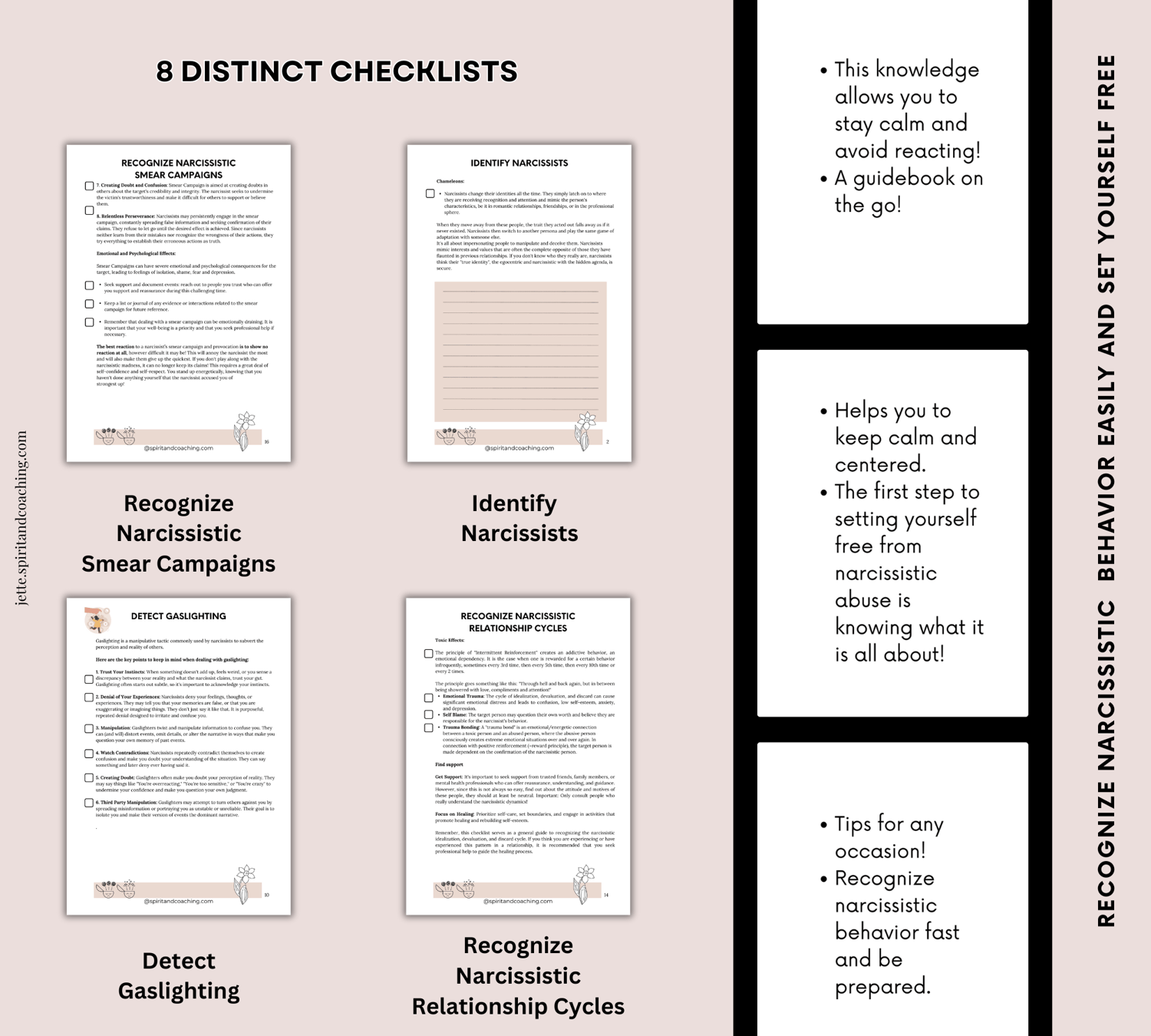
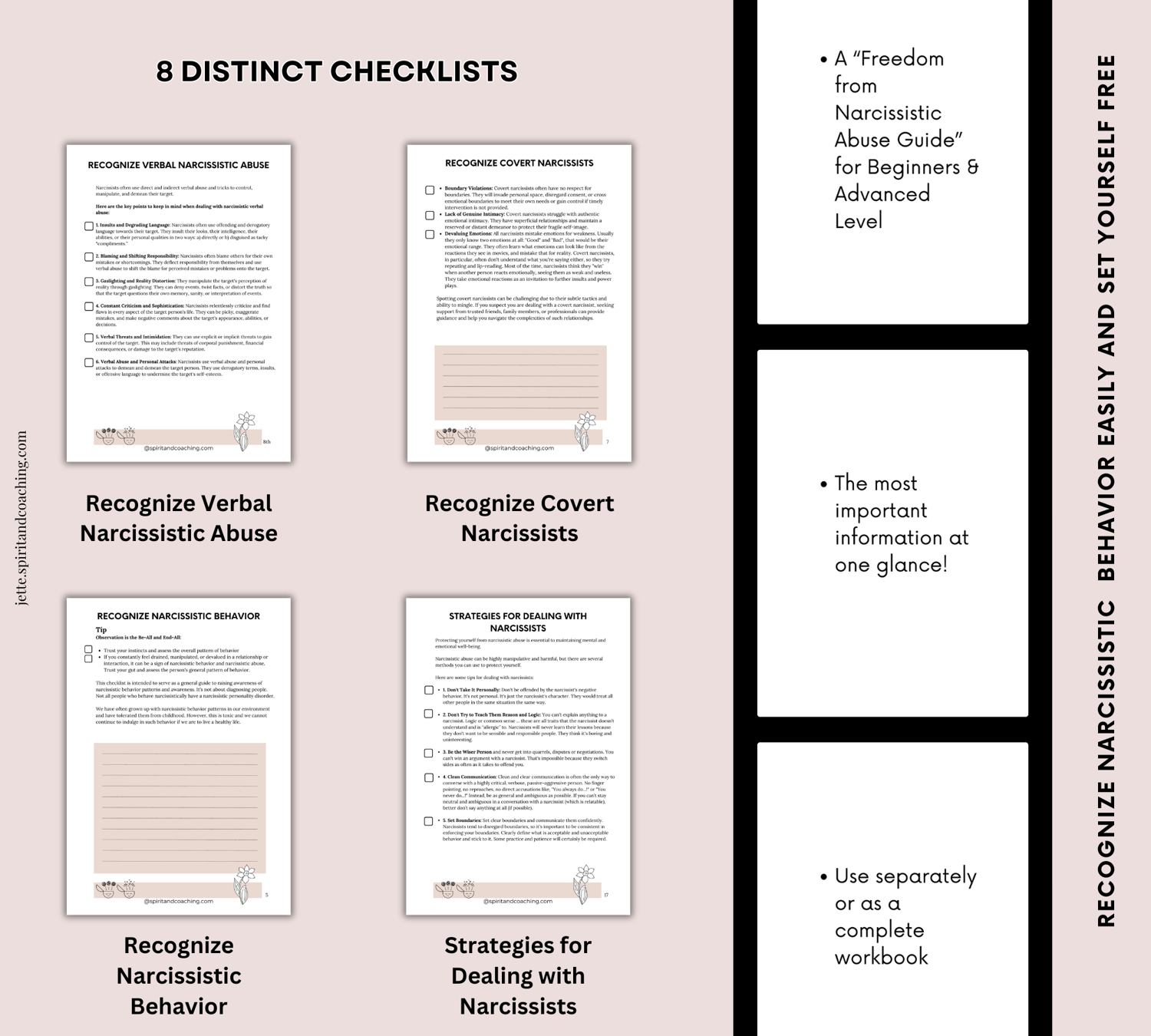
The booklet consists of 8 lists that can be used independently of each other, so that you don't have to read through all the pages first, but can start directly with the topic that is important to you.


Our Narcfree lists will help you become aware of narcissistic behaviors around you. This is the first step towards liberation and healing. You can't break free, if you don't know what you're dealing with. When dealing with narcissists in any way, you inevitably have to find yourself in difficult situations, as narcissists are always trying to trigger you and make your life difficult in different ways.


When we begin to recognize that we are dealing with people who have ulterior motives and do not have our highest good in mind, we can begin to see clearly what we really want. Do we really want to keep being humiliated and oppressed? Do we want to be held down and have our energy, power, and self worth stolen just to make a narcissist feel good? Hardly likely


We've compiled these lists to help you gain clarity and dispel doubts about manipulation issues that are often difficult to spot.


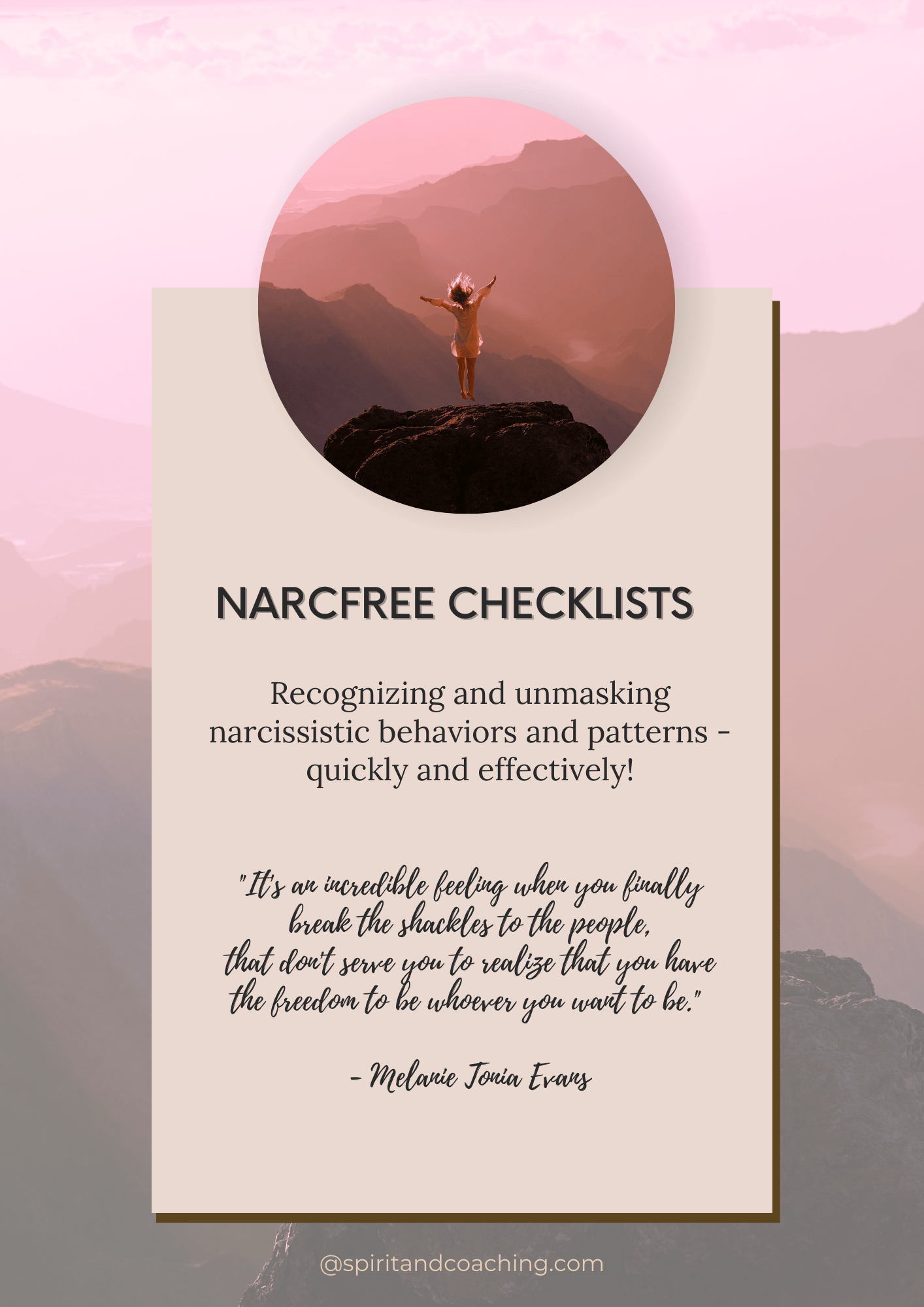
"Narcfree Checklists"


... Are made for you, so that you are always well prepared, because narcissists not only become uncomfortable when you expect them, but rather when you are unsuspecting.


Just when you no longer think about it, narcissists put out their quills. Especially then "Narcfree Checklists" are of great value. You can withdraw for a moment and look up the "Narcfree Checklists" on your mobile phone or tablet to quickly gain clarity. What you should avoid is also written down in the checklists.

When dealing with narcissists, your own mental clarity is the top priority! This will help you not to get drawn into narcissistic games and to remain your sovereignty.


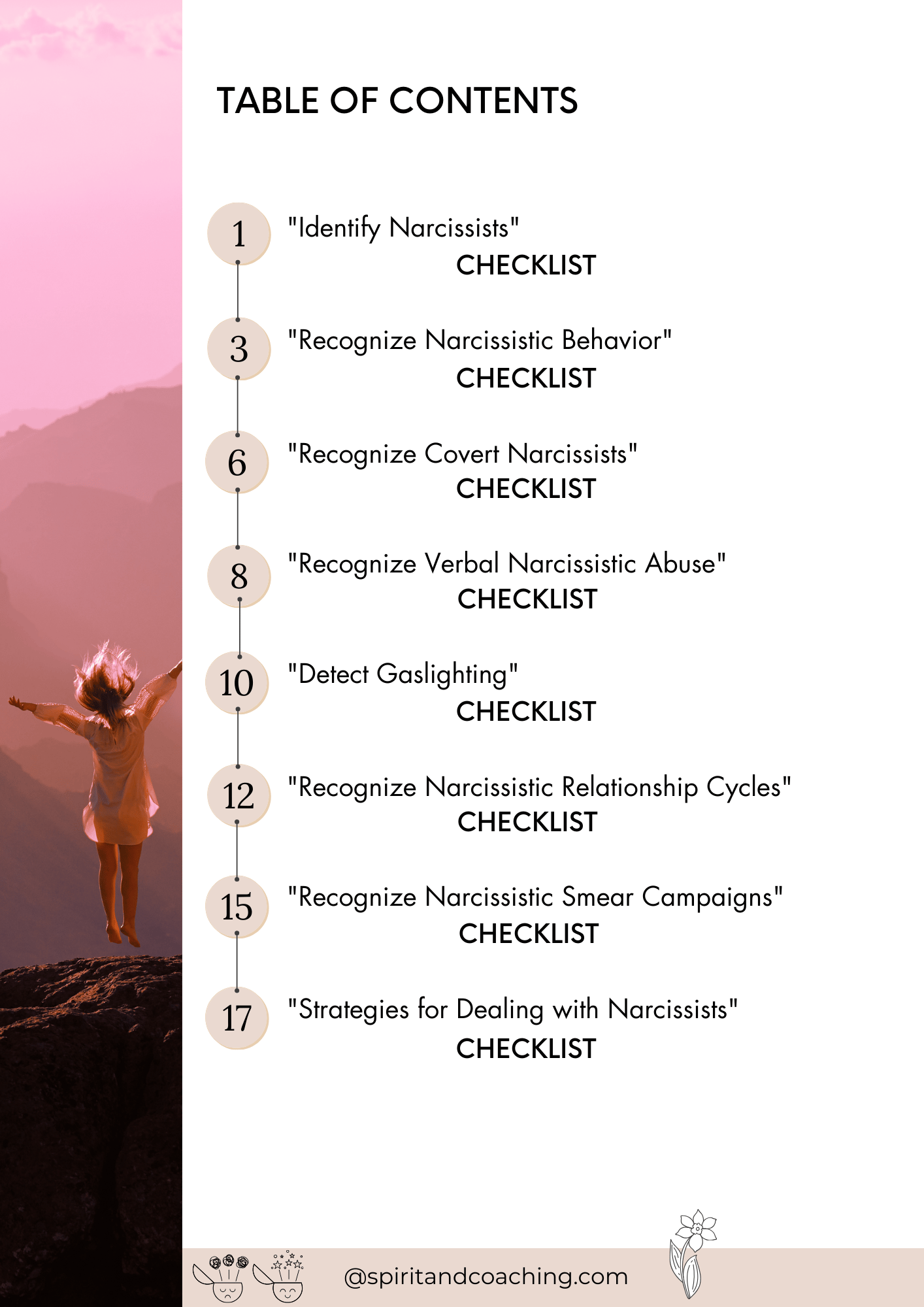
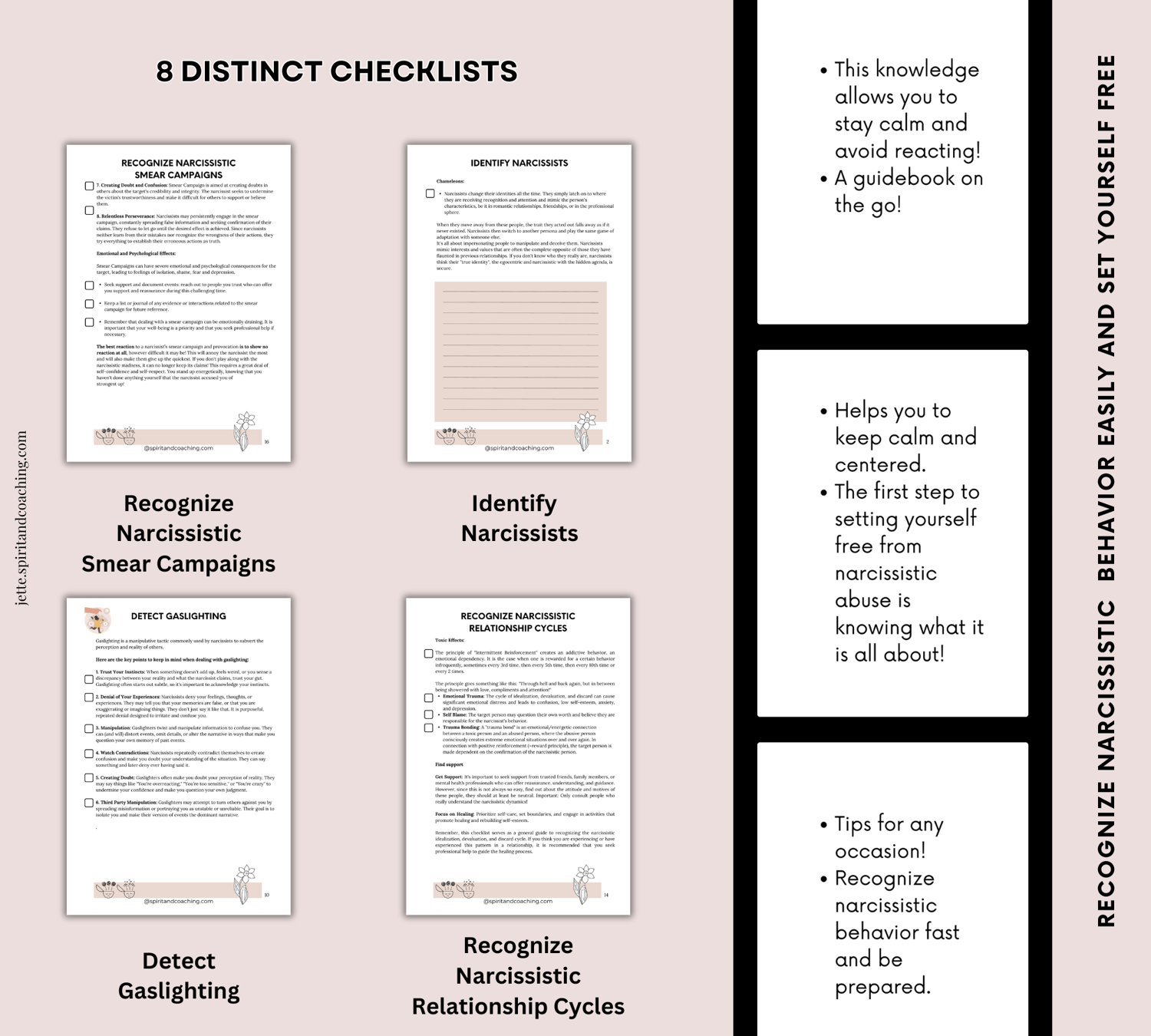
The workbook contains the following checklists:


  • Identify Narcissists
  • Recognize Narcissistic Behavior
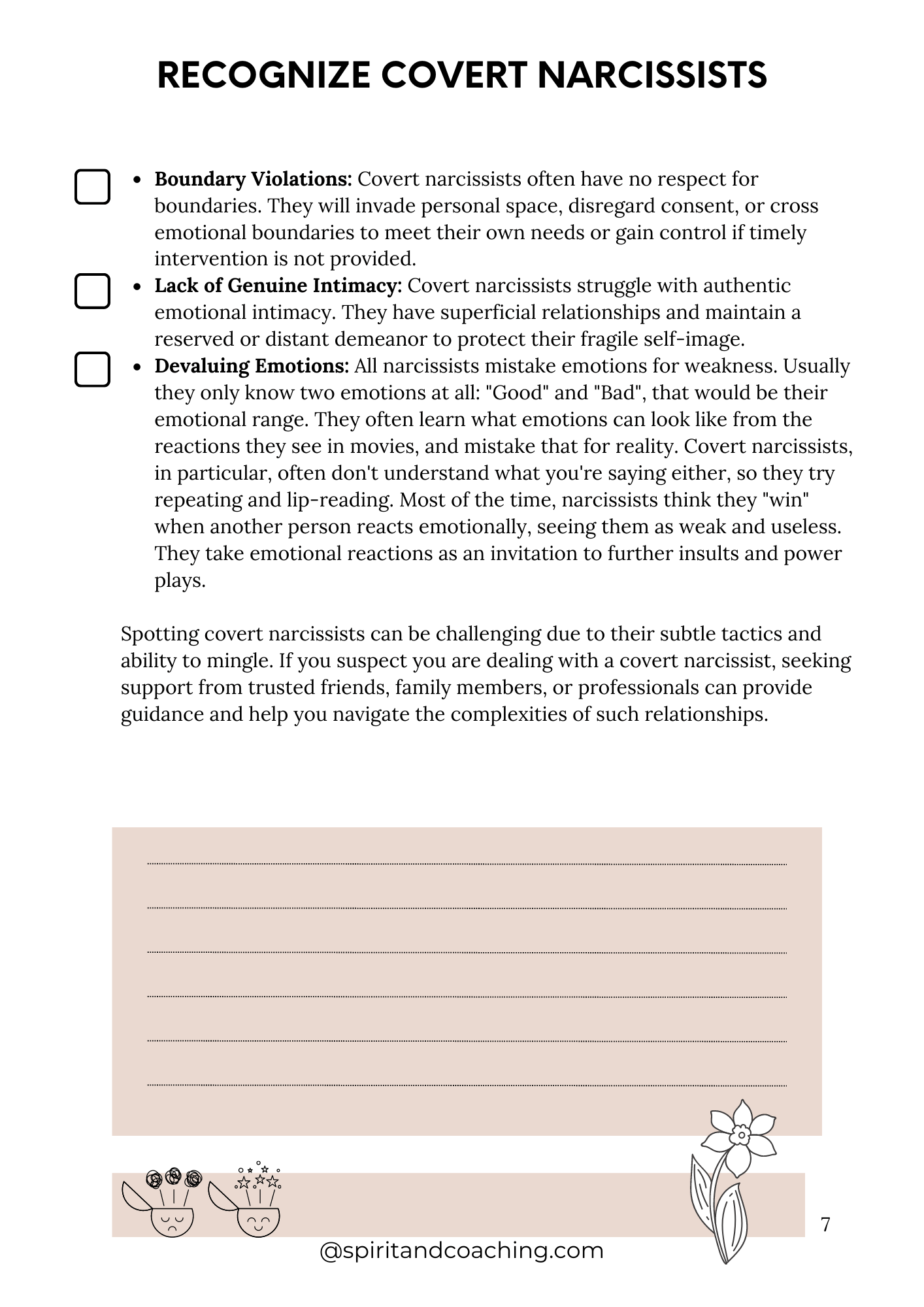
  • Recognize Covert Narcissists
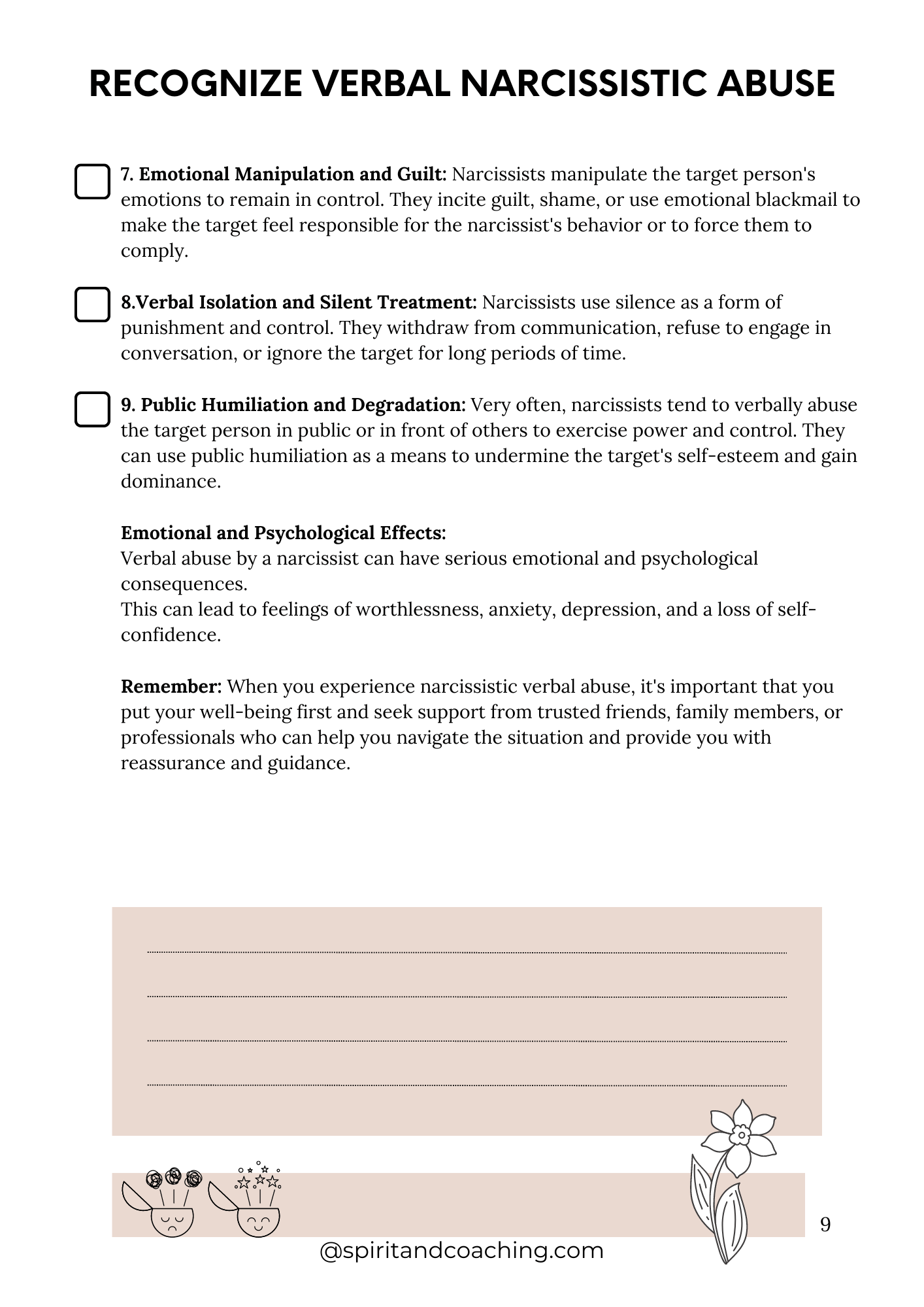
  • Recognize Verbal Narcissistic Abuse
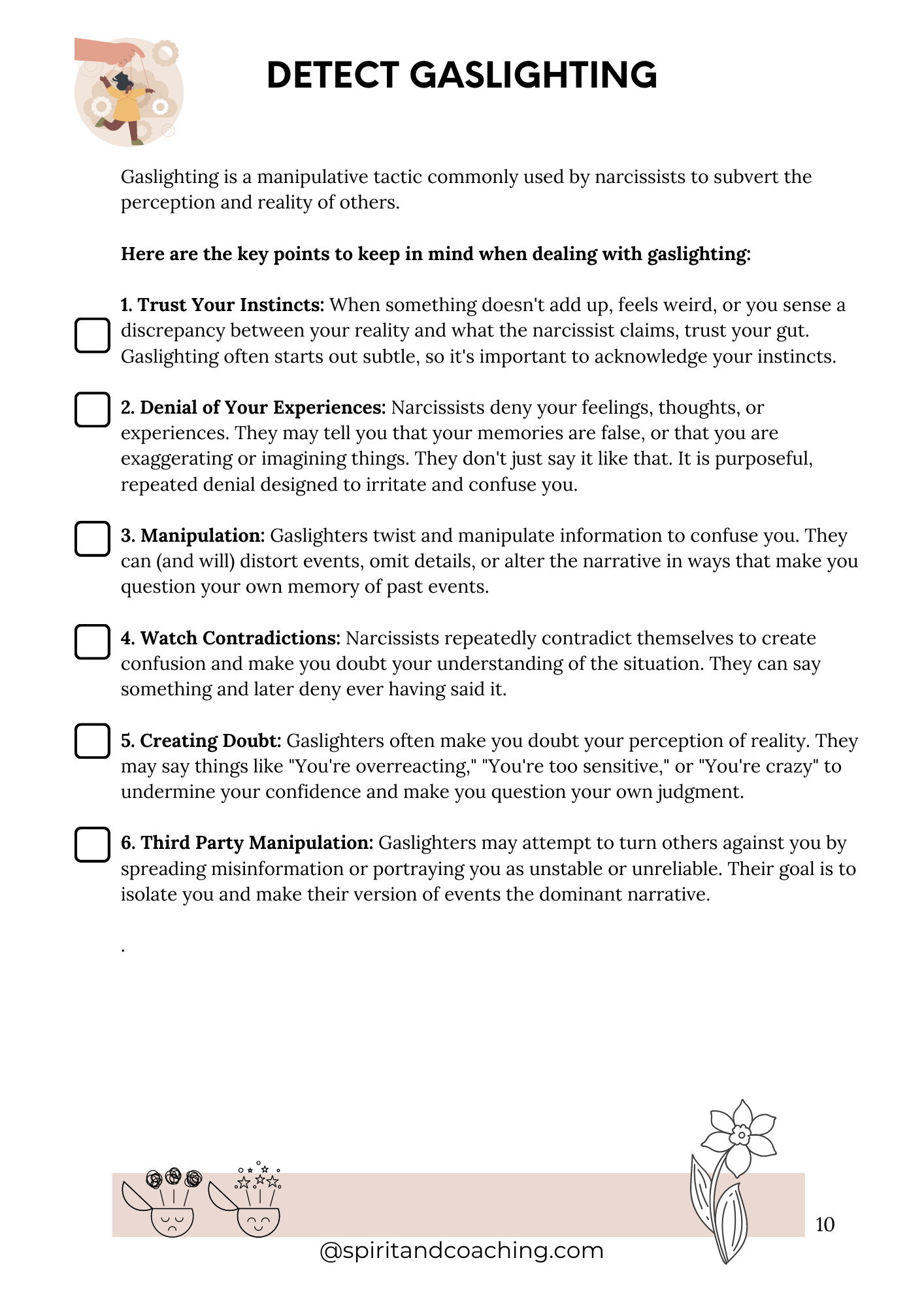
  • Detect Gaslighting
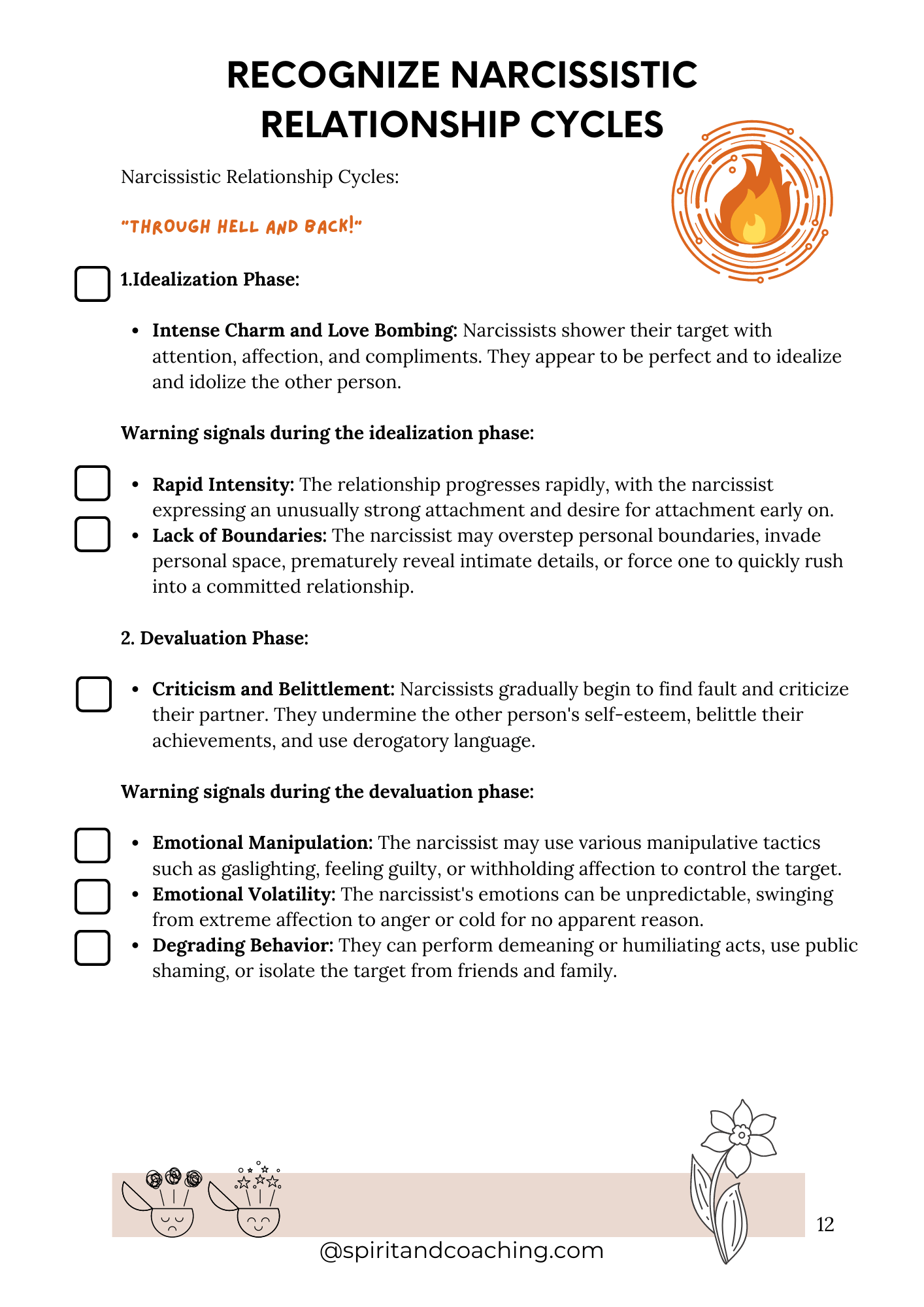
  • Recognize Narcissistic Relationship Cycles
  • Recognize Narcissistic Smear Campaigns
  • Strategies for Dealing with Narcissists


We have often grown up with narcissistic behavior patterns in our environment and have tolerated them from childhood. However, this is toxic and we cannot continue to indulge in such behavior if we are to live a healthy life.


When it comes to narcissistic abuse, the motto is, "No, it's not your fault!" The narcissist just wants you to think and even believe that! But you don't have to do that anymore.


You can also read and use our lists on your mobile phone, so that you always have them at hand, wherever you are. PDF files can be uploaded and labeled on Goodnotes and other apps.


Whenever a way of communicating or behaving seems odd to you, go through the lists that are appropriate. They are designed for different situations so that they provide extensive support for you.

If you have any further questions, send us an email or book a Narcfrei consultation with us.


You are worthwhile!


We wish you every success and good luck 🍀🍀 on your journey to self-determination!


Sincerely,


Jette & team


You receive:


  • 1 Workbook consisting of 8 checklists, 21 pages - digital download
  • 1 PDF file with very high quality
  • 1 PDF file with standard quality


This checklist workbook is intended to serve as a general guide to raising awareness of narcissistic behavior patterns. It's not about diagnosing people. Not all people who behave narcissistically have narcissistic personality disorder.


Copyright:

Please note that you are not permitted to resell or distribute any of our digital products, templates, design assets, icons, or any of their components in any manner. It's important to recognize that all designs are copyrighted.


© Jette A. Hofmann

You will get the following files:
  • PDF (39MB)
  • PDF (10MB)
recognize-narcissistic-relationship-cycles-workbook-jette-hofmann

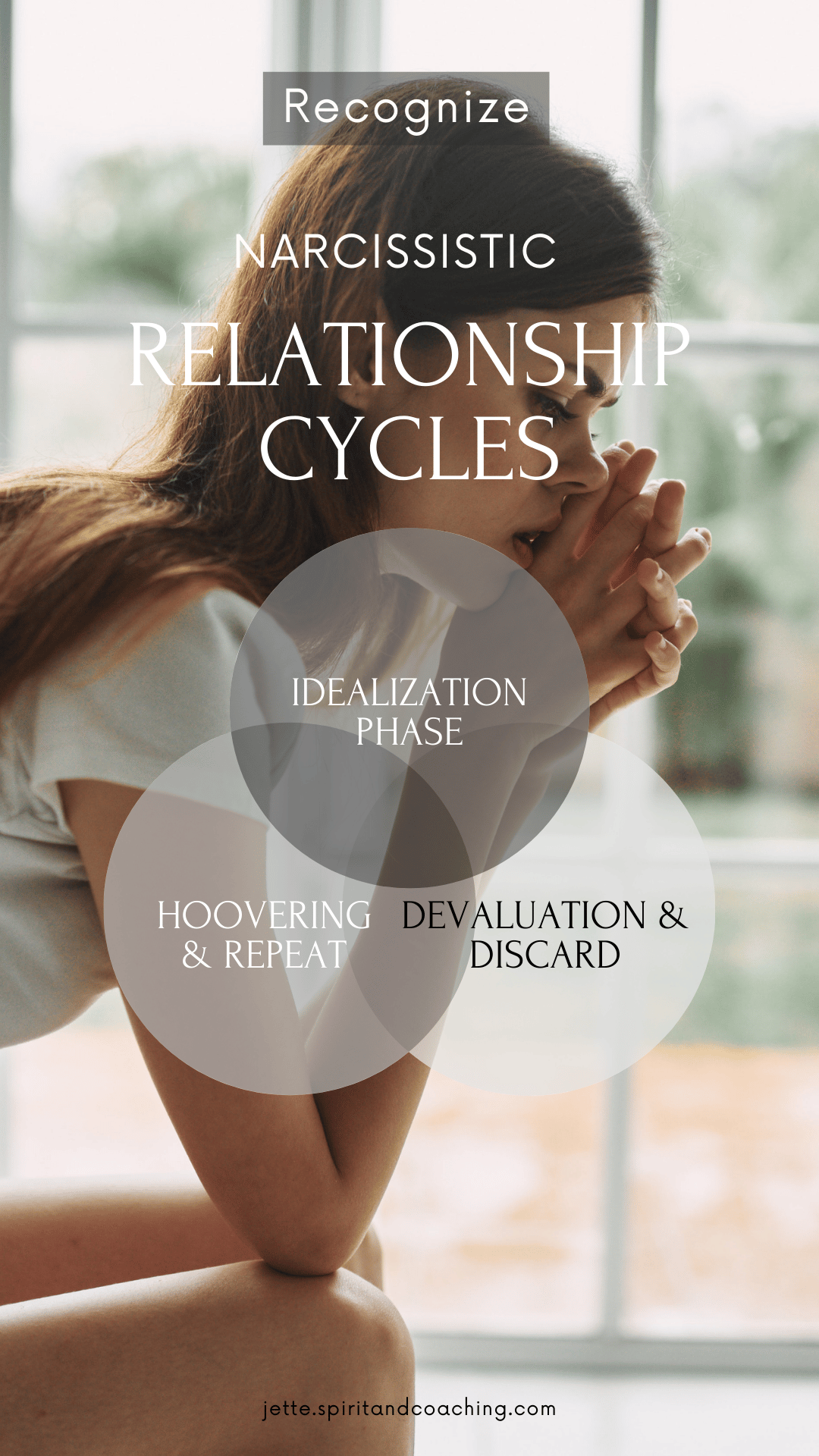
Three Main Narcissistic Relationship Cycles

Three main toxic relationship cycles include the pattern of control and manipulation, where one partner seeks to dominate and manipulate the other; the cycle of emotional abuse, which involves behaviors like belittling, blaming, and isolating the partner; and the cycle of enablement, where one partner enables and covers up the harmful behavior of the other, perpetuating a cycle of dysfunction. Recognizing these cycles is crucial in order to break free from toxic relationships and seek healthier connections.

making-right-decisions-in-relationships-freedom-from-narcissistic-abuse-jette-hofmann

Are you making the right decisions?

When we talk about whether you are making the right decisions, it refers to decisions that are made for your highest good.


In toxic relationships, we often realize that we are neglecting our own interests. Depending on the toxic person's manipulation, we make decisions that either provide security or that solely benefit the other to whom we have an energetic attachment and who may appear "threatening" to us in a certain way.


It's understandable that we want security, but we should also start living our own lives.


When we choose for our own good, it is also in the interest of others. We cannot truly decide for others, but a narcissistic person will continually suggest that we should.


Become aware of your own decision-making.


Namasté

Finding Your True North Despite Narcissistic Rage

Sudden and unexpected outbursts of anger that you didn't expect - this could be Narcissistic Rage.


Narcissists can't be sweet and nice for long, they have to pretend to be nice. Actually, they would like to verbally show off all day long and humiliate, insult and blame others. But since they also want to be the “good guys” because they aren’t really that, they try to hide their tendency to violence and rage for as long as possible. Most narcissists do that, especially covert narcissists.


It's not easy to please others, nor should we, but pleasing a narcissist is almost impossible. So you can calmly let go of any feelings of inadequacy or self-worthlessness. Even if the narcissist insults you and accuses you of saying that everything that ever went wrong in his life was your fault, it's just bullshit or blabbering. Manipulative talk and gaslighting are designed to keep you hooked into demeaning yourself from the narcissist's perspective so that you are always available to him or her.

If the narcissist suddenly freaks out and wants to use you as a lightning rod, then that's his business. Everything that comes out of his mouth is a lie or has been twisted beyond recognition. Narcissists don't tell the truth, they're just good at selling us their tall tales because they're masters of distortion and gaslighting. They use one tiny true detail, which they wrap with lots of lies, so that what they say looks true. But believe me, that's not the case.


Angry narcissists are not entirely harmless and certainly not honest. It's best to move away as quickly as possible without taking the talking, shouting, or anything like that personally. If you were to get angry or put yourself down because of his yelling, that would make the narcissist very happy in the short term, but we’re not doing him that favor.


Sometimes there are signs of the narcissist's future unraveling. They often become briefly annoyed, but then switch back to feigned friendliness. It varies from person to person, of course, but you can sometimes see the narcissist's hot temper gradually increase. But just at the moment when he's acting "normal" and you do or say a tiny little thing that isn't 100% in his spirit, the narcissist explodes. With extremely inappropriate exaggeration, he immediately begins to accuse, insult and devalue you. Any reaction to the egomaniacal freakout only makes it worse. Everything you say is used against you. So you have no other option than to leave the room.


Narcissists don't really like harmony. They crave conflict, and if you let them trigger you, the freakout could turn into a long, heated discussion or argument.


However, there are also narcissists who freak out when you leave the room because they behave negatively, but that is their own problem. You can't please them anyway.

Be the wiser person!


Things to know about "Narcissistic Rage"

Narcissistic rage is a term used to describe intense, angry outbursts or emotional reactions exhibited by individuals with narcissistic personality traits or narcissistic personality disorder (NPD). This phenomenon occurs when the narcissist perceives a threat to their self-esteem, self-worth, or grandiose self-image. It is important to note that not all individuals with narcissistic traits display narcissistic rage, and the severity of such reactions can vary.


Key features of narcissistic rage include:


  1. Overreaction to Perceived Threats: Narcissistic individuals often have fragile self-esteem and a hypersensitivity to criticism or perceived slights. When they feel criticized, rejected, or challenged, they may respond with an intense and disproportionate emotional reaction.
  2. Explosive Anger: The rage associated with narcissistic individuals can manifest as explosive anger, tantrums, yelling, or even physical aggression. This intense emotional response is an attempt to regain a sense of control and superiority.
  3. Lack of Empathy: During a narcissistic rage episode, individuals may become completely absorbed in their own emotions, disregarding the feelings and perspectives of others. This lack of empathy further fuels their need to protect their self-image at any cost.
  4. Projection: Narcissists often project their own insecurities onto others, blaming them for the narcissistic injury. They may accuse others of being jealous, disrespectful, or inferior as a way to deflect attention from their own perceived flaws.
  5. Impaired Judgment: In the midst of narcissistic rage, individuals may display impaired judgment and engage in impulsive behavior. This can include making irrational decisions, saying hurtful things, or taking actions that harm relationships.
  6. Gaslighting at its “best”: Narcissistic rage seems to bring out the most: Narcissistic Rage seems to cause narcissists to engage in extreme twisting and lying. Even if they are normally dishonest, when they are angry they become true masters of distortion. Verbal manipulation just bursts out of them and they are trying to sell this false reality to you using more and more manipulative tactics.
  7. Denial: After the rage episode subsides, some individuals with narcissistic traits may experience remorse or guilt. However, most may deny their behavior, rationalize it, or place blame on external factors or the individuals they lashed out against.


Understanding narcissistic rage is crucial for those who interact with individuals with narcissistic traits, as it can help manage and navigate challenging interpersonal dynamics. It is important to establish healthy boundaries, practice self-care, and seek professional support when dealing with the complexities of relationships involving narcissistic individuals.


finding-your-true-north-freedom-from-narcissistic-abuse-coaching-jette-hofmann

7 Top "Narcfree" Secrets & How to Not Get Affected by Narcissists

Navigating narcissistic people can be challenging, but keeping these seven tips in mind can make it easier:

  1. Don't take it personally: Narcissists want you to take things personally. They want to provoke emotional reactions within you, because then they can control you. Insulting or hurting you is actually not about you, it is all about them. It is about the fragile nature of the narcissist that they try to hide permanently behind power struggles, control and manipulation.
  2. Remember your true self-worth: Narcissists love ruffling your self -worth. It is what they do. If you know who you truly are, their tactic just doesn't work. Don't listen to them.
  3. Remember that some people are just liars: To narcissists, lying is their second nature. Just as some people have a hard time lying, narcissists have a hard time telling the truth. They just infuse a story they make up with a pinch of truth, the rest is fiction.
  4. Recognize that disapproval from a dishonest person is not a bad thing: If a toxic person doesn't approve of you, it is actually a good sign that you're not like them. Very often "Rejection is God's protection!" People who really love you wouldn't do that.
  5. Set Boundaries & Always listen to your body and emotions to determine what is truly right for you: Your body is a truth- and a lie detector. When your stomach is constricting, this is a sign that something weird and at the same time "wrong" is going on, that it would be better to set boundaries and back away.
  6. Don’t fall in the trap of comparing yourself to others: Narcissists love to manipulate people by comparing them to others in an insulting way, subtly or offensively. They tell you that they appreciate other people*s appearance or achievements over yours to your face. They don*t even feel ashamed of their rudeness, they feel entitled to do so. What they have in mind is that after the conversation or gathering you start or keep beating yourself up, putting yourself down and feel ashamed of yourself as a part of emotional manipulation and verbal abuse.
  7. Don’t react, just observe or respond in a self-empowered way: No reaction often is the best reaction, especially when it comes to narcissists. If you react emotionally to a narcissist's provocation, they hook you. They take your reaction as a reason to turn things around, blame you for what they did and prepare the next provocation. Emotion are a symbol of weakness to a narcissist, this is why they project theirs onto others twisting and scheming like crazy!


Narcissistic Splitting - “Black or White?”

Narcissists view others as tools rather than complete individuals. They categorize people as either "amazing" if their desires are fulfilled, or "bad" if not. Their perception is often binary, lacking nuances or shades of gray.


Viewing life in a dualistic way is a very limited philosophy. Things are not just black and white. There are many shades of color to everything you experience. Even if you look at things that you would classify as "negative" at first glance, there is always a positive side somewhere. At the same time, things and situations that you would see as "positive" automatically have a "downside". This is a side effect of polarity. Nobody is just good or just bad.


When we look at things neutrally, we see the many shades of everything without having to judge them. All people have so-called positive and negative characteristics - the power lies in balance. However, narcissists cannot see this. It is important not to take them at their word and to recognize that "narcissistic splitting" is an inadequate way of looking at an individual that lacks any truth. People who only use others for their own purposes only use evaluations and devaluations or "useful and useless" as a method of manipulation. That doesn't say anything about you at all, it just says that the narcissist is demonstrating a very limited perspective. As a child, you obviously don't understand something like that, but it's important for adults to recognize narcissistic manipulation methods in order to get out of the game and set a good example for others.


About “Narcissistic Splitting”


"Narcissistic splitting" refers to a defense mechanism commonly observed in individuals with narcissistic personality traits or Narcissistic Personality Disorder (NPD). It involves viewing people, situations, or even oneself as either all good or all bad, with little room for nuance or complexity. This black-and-white thinking can lead to distorted perceptions, erratic behavior, and difficulties in maintaining stable relationships.

In narcissistic splitting, individuals may idealize certain people or aspects of themselves while devaluing or demonizing others. For example, they might idolize someone they admire one moment, only to vilify them the next over minor disagreements or perceived slights. Similarly, they may alternate between seeing themselves as flawless and faultless to feeling worthless and inadequate, often depending on external validation.


Dealing with narcissistic splitting can be challenging, but there are some strategies that may help:


  1. Set Boundaries: Establish clear boundaries to protect yourself from being pulled into the individual's extreme judgments or manipulative behaviors. Recognize that you cannot change their thinking, but you can control how you respond to it.
  2. Maintain Perspective: Remember that the individual's extreme views are a reflection of their internal struggles and insecurities, rather than an accurate portrayal of reality. Try not to take their fluctuating opinions personally.
  3. Avoid Reactivity: Narcissistic individuals may provoke reactions to fuel their sense of power and control. Practice emotional regulation and refrain from engaging in heated arguments or defensive responses.
  4. Practice Empathy: While it's important to protect yourself, try to understand the underlying reasons for the individual's behavior. Empathy doesn't mean condoning their actions, but it can help you approach interactions with more compassion and patience. And even more important: Practice empathy for yourself. Then you become independent of other people’s judgements
  5. Seek Support: Dealing with someone who exhibits narcissistic splitting can be emotionally draining. Reach out to friends, family, or a therapist for support and guidance in managing your own well-being.
  6. Encourage Accountability: If appropriate and safe to do so, gently challenge the individual's extreme views and encourage them to consider alternative perspectives. However, be prepared for resistance or deflection.
  7. Focus on Self-Care: Prioritize your own self-care and well-being. Engage in activities that bring you joy, maintain healthy boundaries, and prioritize relationships with individuals who respect and validate your experiences.

It's important to recognize that addressing narcissistic splitting often requires patience, understanding, and consistent self-care. In some cases, professional intervention may be necessary, particularly if the individual's behavior is causing significant distress or harm to themselves or others.


Your Empowered Self


You don't have to make yourself small

You don't need to crawl, you don't need to beg, you don't need a muzzle, you don't need people trying to pack you into a mini box for you to shrink into.

You don't need screamers who can't communicate properly. You don't need

bad-tempered grumpies who don't begrudge you your joy.


You need you. The true you.

You need you big, you need you strong, you need you bright, you need you smart, you need you empathetic, you need you wise.


So grow back into your bright true presence.


You're worth it.

An’anasha

freedom-from-narcissistic-abuse-workbook-jette-hofmann

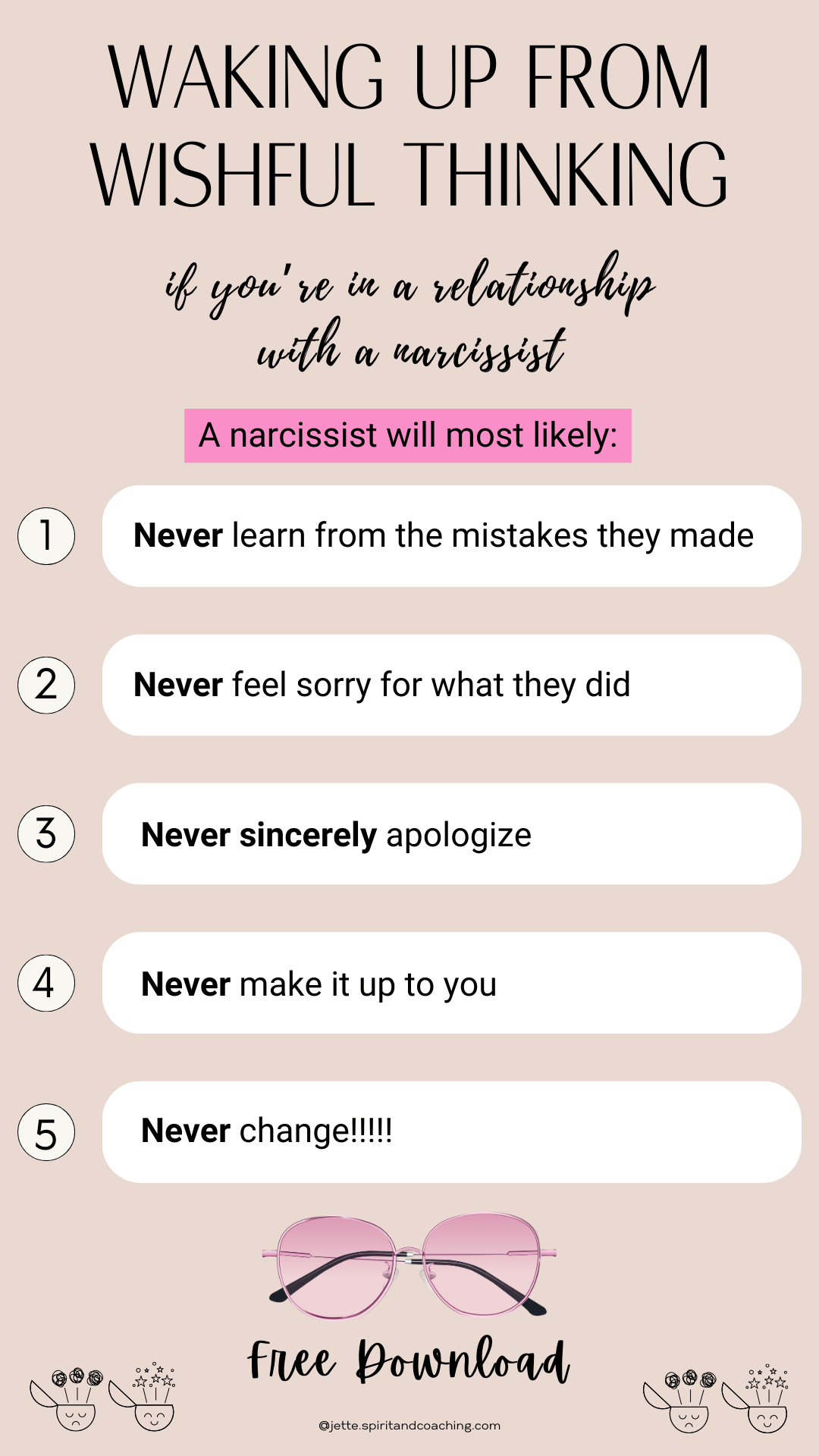
Wishful Thinking in Relationships with Narcissists

No pink glasses anymore, please!


When we are in a relationship with one (or more) narcissists - be it a partner, family, friend group or at work - we can waste a lot of time waiting for the narcissistic person to “reform”.


Narcissists don't want to “better themselves”, they want to manipulate other people and use them for their own purposes.


They promise us the best of luck, but they don't implement it because they have no intention of doing so. Future faking is just one method in which we are promised a great future together, but not the slightest thing is kept.


Narcissists see no reason to change because in their eyes they are always right and do everything right. However, sometimes they already know that they were wrong. In this case, they still do not admit their mistakes, but repeat the same mistakes until they believe that they have acted correctly. They then simply get used to the wrong behavior.


This clearly shows that they are not really capable of learning, at least in the emotional and interpersonal areas.


Narcissists quickly learn on the other hand how to get the things they want - through manipulation, for example. In this they are “learning world champions”, but self-reflection is foreign to them.


If they always get away with what they do because people are afraid of them and believe everything they say, why should they change that?


In my many years as a coach, I have never seen a narcissist


a) keep a promise or

b) learn something from their behavior.


If you try hard to educate, convince or teach a narcissist to behave better, you are wasting your valuable life time.


The narcissist only pretends for a brief moment that he has changed. He can do that very well and you can believe him, especially if you don't look too closely. But then he falls straight back into his old behavior.


Clients are usually very surprised, even though this has been pointed out to them.


Well, it just doesn't make sense to common sense. And this is why we don't understand their contradictory behavior in the first place.


It is therefore particularly important to pay close attention to how the person actually behaves and to pay less attention to what they say and promise. Because that's usually just hot air that quickly evaporates.


So please don't waste any more time hoping that the narcissist would have an insight. It's not going to happen. Unfortunately!


Love & Blessings from Jette

Jette-Hofmann-Coaching-Healing-from-Narcissistic-Abuse-the-Journey

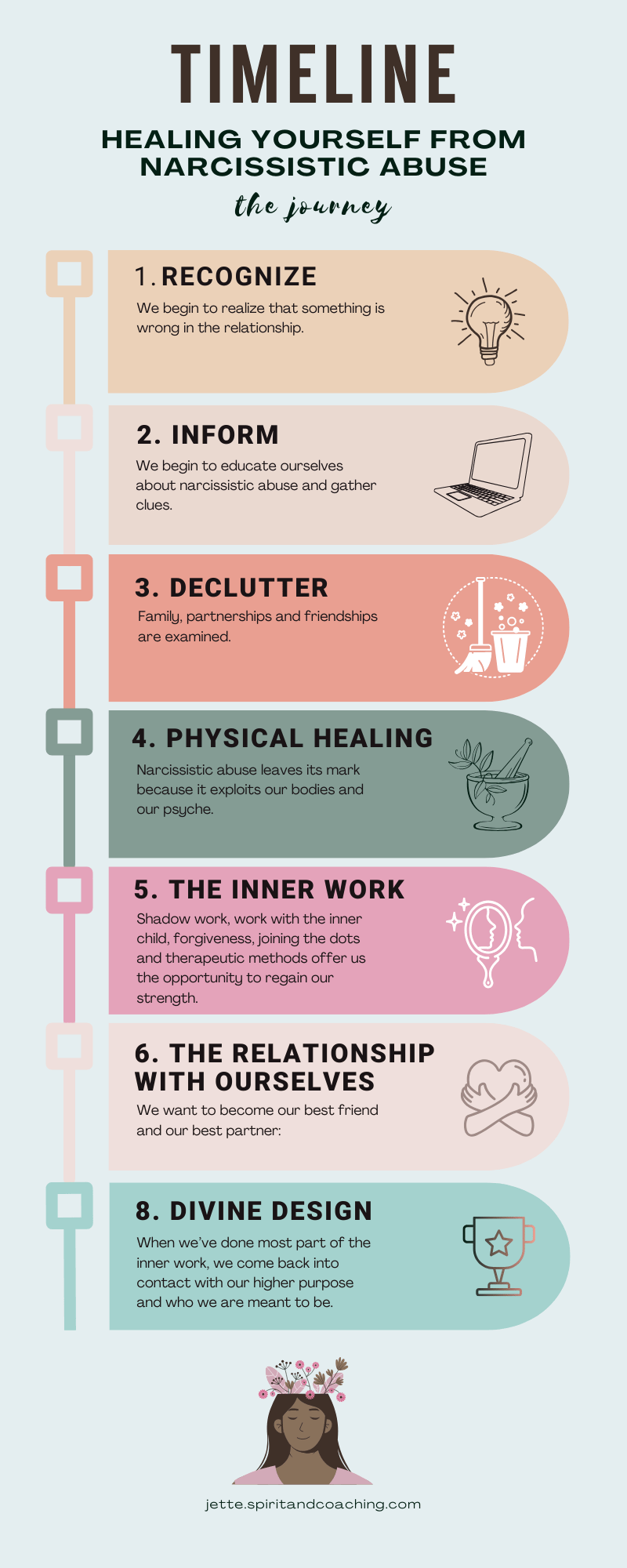
HEALING FROM NARCISSISTIC ABUSE PROCESSES IN DIFFERENT STAGES


HEALING FROM NARCISSISTIC ABUSE PROCESSES IN DIFFERENT STAGES

The steps that are leading to your highest potential can be summarized into "The way out is the way through!". Everything you have experienced so far is a step towards your highest potential. It is super important not to skip the crucial steps into healing yourself.


1.) Recognize


We begin to realize that something is wrong in the relationships. Now we notice that the processes and dynamics in the family or partnership are not healthy and not normal.


2.) Inform


We begin to educate ourselves about narcissistic abuse and gather clues. Fortunately, today we have the opportunity to find a lot of information about toxic relationships and narcissism on the Internet. We can learn that not everything is “our fault” and also that we are NOT the problem, contrary to what narcissistic people claim.


3.) Declutter


Family, partnerships and friendships are examined. We are asked to finally "clean out" properly in order to remove, as far as possible, things and people that do not serve our highest good from our lives. We cannot heal if we continue to surround ourselves with toxic aspects. Of course you can't separate yourself from everyone, but you should set clear boundaries and maintain them. There is a lot to consider here.


4.) Physical Healing


Narcissistic abuse leaves its mark because it exploits our bodies and our psyche. Many of us find ourselves in physical, psychological and energetic burnout. There are typical areas of illness that occur in connection with complex post-traumatic stress disorder, including migraines, muscle tension, burnout (already mentioned), fibromyalgia, depression, anxiety, asthma, arthritis, digestive disorders, etc.


5.) The Inner work


The inner work is super important for healing trauma. Shadow work, work with the inner child, forgiveness, joining the dots and therapeutic methods offer us the opportunity to regain our strength. The detoxification of the body and soul should also be taken into account and included in the healing. It is essential to implement this step. Working with our energy field and the quantum field is particularly important.


6.) The Relationship with Ourselves


We want to become our best friend and our best partner: This is the only way we can be completely independent and free from others. Emotional freedom and independence is the path to fulfilling relationships of all kinds.


7.) Divine Design


When we have done the most important inner work, accepted ourselves again and prioritized, we come back into contact with our higher purpose and who we are meant to be. We now know that we finally want to be who we really are again. Now we are ready to develop our full higher potential. We are on the journey of self-expression. We can learn to thrive, enjoy our lives and be Goddess/Master of our lives.

empowerment-and-drama-triangle-narcissistic-abuse-freedom-jette-hofmann

"Drama Triangle" & "Empowerment Triangle" - What's that?

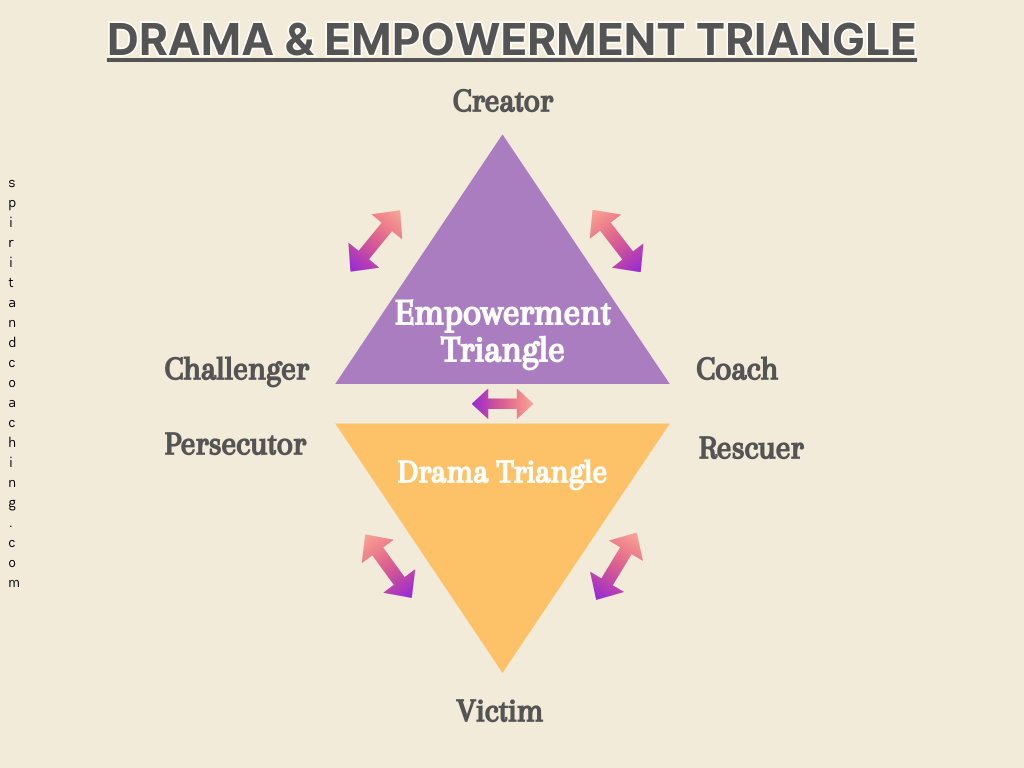
The “Drama Triangle” and “Empowerment Triangle” are frameworks used to understand social interactions and relationships.


The “Drama Triangle” is a model of dysfunctional social interaction that consists of three roles:

victim, persecutor & rescuer

These roles are played out when people engage in unhealthy and unproductive communication patterns.

The “Empowerment Triangle” is an alternative model that emphasizes three roles:

creator, coach & challenger

These roles promote healthy and productive communication patterns by empowering individuals to take responsibility for their actions, while also providing support and guidance.

The Empowerment Triangle is a more positive and effective way of interacting with others, as it encourages personal growth and development.

The Toxic Web of Triangulation in Relationships

As toxic people cannot tolerate or accept all people as equal they create separation and divide amongst others. They’re telling lies that others might have said about the victim taking things out of context in order to create conflict and divide amongst the two parties they’ve created. The toxic person’s goal is to be the only one to control the entire system without others noticing it to keep their hands clean when they aren’t.


Triangulation in toxic relationships is a destructive dynamic that can lead to emotional turmoil and lasting scars for those involved. It's a manipulation tactic where one person (often the toxic individual) strategically involves a third party to create confusion, jealousy, or insecurity within the relationship. This triangulation can manifest in various ways, such as seeking the attention of an ex-partner, comparing their current partner to someone else, or even enlisting a friend or family member to mediate conflicts.


5 Key aspects to understand about triangulation in toxic relationships:


  1. Undermining Trust: Triangulation erodes trust within the relationship by introducing doubts and suspicions. When one partner consistently involves others in their problems or complaints, it can make the other feel like they are constantly being judged or evaluated.
  2. Emotional Manipulation: The toxic individual uses triangulation as a means of control. By making their partner feel inadequate or insecure, they gain power and control over the relationship. The fear of losing their partner to someone else keeps the victim in a state of anxiety and submission.
  3. Isolation: Triangulation often isolates the victim, making them feel like they can't confide in friends or family because they might be judged or misunderstood. This isolation can make it even more challenging to break free from the toxic relationship.
  4. Cycle of Abuse: Triangulation is a part of a broader cycle of emotional abuse that includes love-bombing, devaluation, and discard phases. The victim is repeatedly subjected to a rollercoaster of emotions, making it difficult to leave the relationship.
  5. The Drama Triangle:The drama triangle is a social model that describes dysfunctional and conflict-driven interactions among individuals. It consists of three roles: the victim, the persecutor, and the rescuer. In this dynamic, individuals often switch between these roles, perpetuating a cycle of conflict and drama within relationships or group settings.


Each triangulation system makes use of the victim-persecutor-rescuer triangle. The toxic individual wants to control the system. They therefore jump between all three roles victim-persecutor-rescuer in order to hide their agenda.


  • They’re using the scapegoat - usually the person who is alone or who is the most sensitive - to become an “unwanted” party nobody approves of.
  • They’re also using the “golden child” or the “flying monkeys” - people they approve of being able to do the toxic person’s dirty work - to create conflict, confusion, separation and divide amongst the two parties.


The scapegoat is supposed to become the isolated victim - easy to control. The “flying monkeys” are supposed to create misunderstandings, smear campaigns or arguments to attack the scapegoat.


It is not always clear in the first place who’s the victim here or who’s the persecutor. Fact is that the toxic person jumps between all roles to hide their agenda. The scapegoat is the actual victim, the “flying monkeys” are playing the role of the persecutor, so that the toxic person is able to play the “rescuer” off the hook.


Sometimes it is obvious that they’re the actual persecutor, because toxic people aren’t able to simulate the nice guy for long. Then they can be seen as the persecutor while the “flying monkeys” become the rescuers for a short time.


Interestingly - or not - the toxic person will always try to convince everyone of the scapegoat being the persecutor. Toxic people are expert in this scheming, so that most people don’t get it and tend to join the toxic game.


Tips that can help you once you’ve recognized triangulation is going on in your relationship or family


Seeking Help: Recognizing triangulation and seeking help or support from a therapist, counselor, or support group can be crucial for the victim's well-being. Therapy can help victims regain their self-esteem, identify toxic patterns, and develop the strength to leave the relationship if necessary.


a.) Establishing Boundaries: Setting clear boundaries with the toxic individual is essential. Boundaries help protect one's emotional well-being and prevent further manipulation. However, it's important to note that the toxic person may resist these boundaries and escalate their tactics in response.


b.) Ending the Relationship: In many cases, the only way to break free from the toxic cycle of triangulation is to end the relationship. Leaving a toxic relationship can be challenging, but it's often the healthiest choice for one's mental and emotional well-being.


In conclusion, triangulation is a harmful tactic used in toxic relationships to manipulate and control the victim. Recognizing this dynamic and seeking help and support are crucial steps toward breaking free from the cycle of abuse and creating a healthier, more fulfilling life.


Jette-Hofmann-Freedom-from-Narcissistic-Abuse-Coaching-Narcissistic-Thoughts-Signs

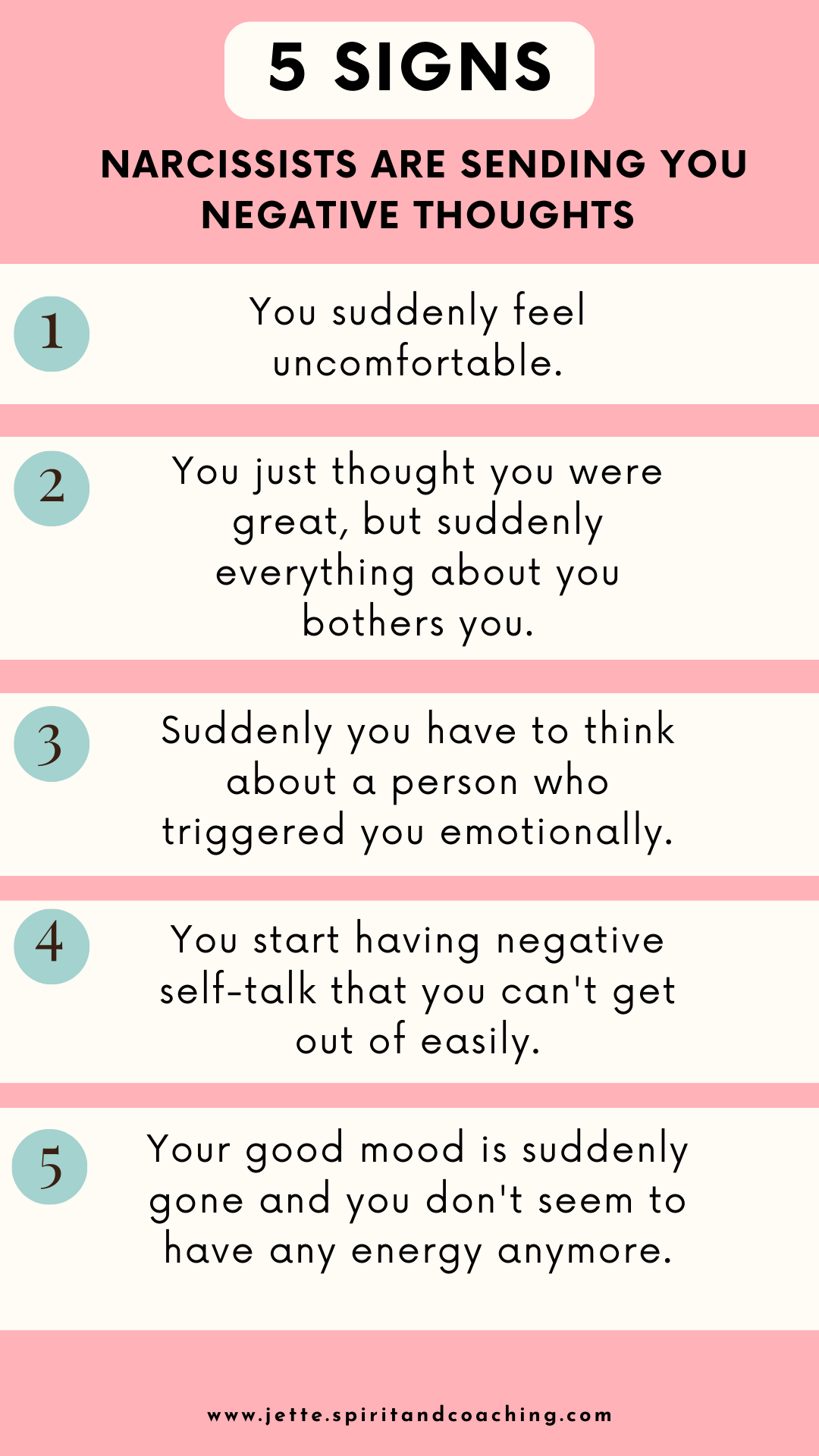
How to Recognize Thoughts that come from Narcissists

First of all narcissistic thoughts aren't uplifting. They're judgemental, undermining and hypercritical. When you suddenly start to criticize youself, gues what .. These thoughts may come from a toxic person. They usually come out of the blue and because they are toxic you want to recognize them quickly and get back on track. Love, Jette

Jette-Hofmann-Freedom-from-Narcissistic-Abuse-Checklist-Coaching